
We have prepared this comprehensive pre-lodgement FBT checklist to assist tax managers, payroll managers, and those involved in preparing the 2026 Fringe Benefits Tax (FBT) return in Australia.
The checklist is designed to cover all the main benefit categories, and also outlines the reportable fringe benefits amounts (RFBA) and single touch payroll (STP) Phase 2 reporting steps. Use this as your go-to resource before your 2026 FBT lodgement deadline.
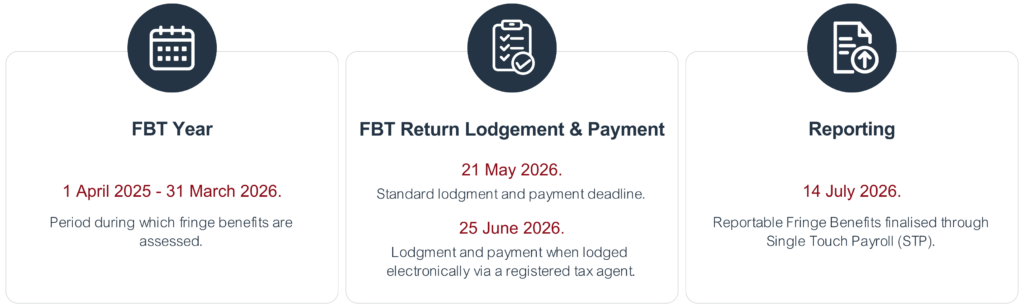
FBT 2026 Key Dates & Deadlines
1. Motor Vehicles & Car Benefits
1. Review Asset Registers to identify all potential vehicles made available for private use.
2. Review any salary sacrifice and novated lease arrangements to ensure all vehicles are correctly captured.
3. Review all vehicle calculations to ensure correct method is selected (statutory formula vs operating cost method).
4. Ensure logbooks are compliant and up to date (12-week period, updated every 5 years or when usage changes).
5. Check base values for all vehicles – check back to base value supporting documents, consider any reductions for vehicles held more than four FBT years.
6. Confirm all employee contributions are post-tax and are documented.
7. Validate odometer readings at start and end of FBT year.
2. Car Parking
1. Review current tenancy agreements and what parking spaces are provided to employees
2. Consider the 1km radius test: Is there a commercial parking station within 1km charging above the ATO daily threshold?
3. Use the correct daily car parking threshold for 2025–26 FBT year ($11.03).
4. Consider whether any eligibility for the small business car parking exemption.
5. Where FBT will arise on parking benefits provided, consider valuation options and the use of an external car parking rate provider to reduce FBT costs.
6. Consider whether electronic data of the use of car parking facilities is available for more accurate FBT costings.
7. Maintain accurate records of parking arrangements and any contributions from employees.
3. Entertainment & Meal Benefits
1. Identify all entertainment-related expenses (meals, events, staff functions).
2. Consider what detail is available of attendees for each event and which entertainment calculation methodology will utilised, Does the granular detail exist of all attended at all events or will the 50/50 method need to be elected?
3. If can utilise the actual method, consider how will apply the minor benefits exemption (items below $300, provided infrequently and irregularly).
4. Document all supporting evidence for entertainment cost breakdowns.
5. Consider recreational entertainment, tickets, corporate boxes, and conferences.
6. Consider what can be reasonable excluded as not being meal entertainment subject to FBT, depending on methodology selected.
4. Living Away From Home Allowance (LAFHA) – FIFO & Remote Employers
1. Check with HR and Payroll teams as to who has been provided to employees as cash or other LAFHA benefits.
2. Confirm LAFHA is only provided for genuine temporary relocations in line with the provisions and ATO guidance..
3. Review relevant contracts and assignment letters.
4. Retain supporting documentation: employee declarations, evidence of additional costs, and duration of assignment periods. – Review eligibility for FIFO treatments and remote area benefits if applicable – ensure compliance with ATO guidance and seek clarifications as needed.
5. Other Benefit Categories
1. Undertake a review of trial balance accounts to identify other potential benefits.
2. Review work-related items (laptops, phones, tools) for exemption eligibility.
3. Consider if your business has expatriate benefits (e.g. Flights, accommodation, tax payments, insurances, etc.). Consider benefits provided overseas.
4. Consider if the business has helped to relocate any employees in the FBT year and assisted with benefits and costs.
5. Check salary packaging arrangements for correct FBT treatment.
6. Consider all other common fringe benefits with the HR and management teams (e.g. housing, loans, long service awards, gift cards, tickets, other expense payments).
6. Record-Keeping & Documentation
1. Ensure all declarations, logbooks, elections, and supporting documents are up to date and obtained prior to lodgement.
2. Review processes for collecting and storing evidence for each benefit category.
7. RFBA & STP Phase 2 Reporting
1. Prepare draft workpapers and returns.
2. Calculate reportable fringe benefits amounts (RFBA) for each employee.
3. Prepare for Single Touch Payroll (STP) Phase 2 reporting requirements and ensure RFBA is included in finalisation process.
4. Cross-check RFBA figures with FBT return and payroll records. Consider flow on payroll tax and workers compensation insurance premium implications of FBT amounts.
8. Pre-Lodgement Review
1. Critically consider what is provided to employees and whether it is being appropriately addressed for FBT purposes.
2. Reconcile all benefits provided with knowledge of trial balance, payroll and finance records.
3. Double-check calculations for each benefit category, don’t just roll over prior year.
4. Confirm all deadlines including lodgement and payment obligations are scheduled on time.
What This Means for You
- Early and thorough review of all benefit categories reduces the FBT rush for lodgement and therefore reduces audit risk and ensures FBT compliance.
- Ensure appropriate review and lodgement on time to avoid penalty risks.
- Review all benefits provided and trial balance accounts to ensure full coverage.
- FIFO and remote employers must pay special attention to LAFHA documentation.
- Accurate RFBA and STP Phase 2 reporting is essential for employee income statements.
Next Steps / Andersen Perspective
Download the full PDF checklist for detailed step-by-step guidance, templates, and compliance tips.
For tailored advice or a pre-lodgement review, contact Andersen Australia’s FBT specialists.
FBT 2026 Hub
Stay up to date with all of our FBT insights, guides and practical resources in our FBT 2026 hub:
©Andersen Australia Pty Ltd. All Rights Reserved. Andersen is the Australian member firm of Andersen Global, an association of legally separate, independent member firms located throughout the world providing services under their own name or the brand “Andersen,” “Andersen Tax,” “Andersen Tax & Legal,” or “Andersen Legal.” Andersen Global does not provide any services and has no responsibility for any actions of the member firms, and the member firms have no responsibility for any actions of Andersen Global. No warranty or representation, express or implied, is made by Andersen, nor does Andersen accept any liability with respect to the information and data set forth herein. Distribution hereof does not constitute legal, tax, accounting, investment or other professional advice.