
As the 2026 Fringe Benefits Tax (FBT) year approaches its critical deadlines, employers across Australia face a familiar but high-stakes compliance landscape. With the FBT rate holding steady at 47% and the Australian Taxation Office (ATO) sharpening its audit focus, now is the time to review your processes, understand the latest requirements, and act decisively to avoid costly surprises.
This alert distils the essential FBT 2026 dates, rate and gross-up factors, and the ATO’s confirmed audit priorities plus three urgent actions every employer should take before 31 March. Read on to ensure your organisation is prepared and to access the rest of Andersen Australia’s FBT 2026 series.
What’s new for FBT 2026?
The FBT year runs from 1 April 2025 to 31 March 2026. The FBT rate remains at 47% for this period, with no announced changes to the core rate or gross-up factors. The Type 1 gross-up rate (for benefits where GST credits can be claimed) is 2.0802, and the Type 2 gross-up rate (where GST credits cannot be claimed) is 1.8868. These rates are unchanged from previous years and apply to all employers, including not-for-profits and government entities.
Key FBT 2026 Dates
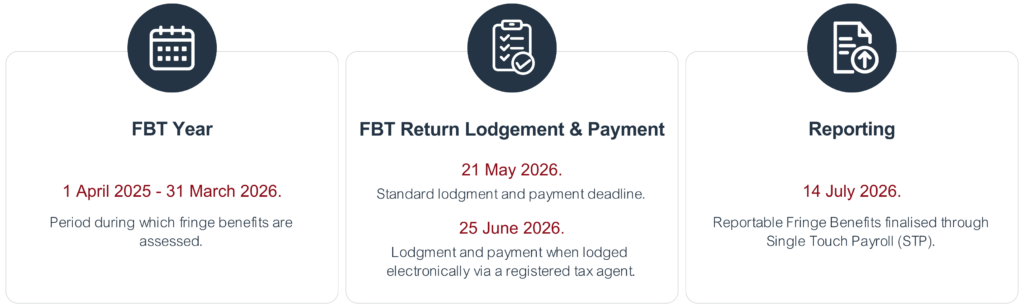
Quarterly FBT instalments may apply if your FBT liability last year was $3,000 or more.
ATO Audit Focus Areas for 2026
The ATO has confirmed its ongoing focus on:
- Correct calculation and reporting of car fringe benefits, including logbook and statutory formula methods.
- Salary packaging arrangements, especially for not-for-profits and health sector employers.
- Entertainment benefits and correct application of the minor benefits exemption.
- Accurate reporting of reportable fringe benefits on employee income statements.
- Record-keeping compliance, particularly for travel, meal entertainment, and living-away-from-home allowances.
Three Urgent Actions for Employers Before 31 March
1. Review all benefits provided to employees and confirm correct classification and valuation.
2. Check your record-keeping processes, especially for car benefits, entertainment, and salary packaging.
3. Ensure reportable fringe benefits are accurately calculated and ready for inclusion in employee income statements.
What Does This Mean for You?
With the ATO’s continued scrutiny of FBT compliance, it’s critical to review your FBT processes now. Early action can help avoid costly errors, penalties, and audit risk.
This alert is the first in Andersen Australia’s FBT 2026 series. Watch for deep dives on car benefits, salary packaging, and sector-specific issues in the coming weeks.
Next Steps
Contact Andersen to help you navigate the FBT season, review your compliance, and prepare for any ATO queries. Our team can support you with tailored advice, process reviews, and training for your finance and HR teams.
Key Reference Links
Nil lodgement (where necessary steps may not have been taken by the employer): https://www.ato.gov.au/businesses-and-organisations/hiring-and-paying-your-workers/fringe-benefits-tax/fbt-registration-lodgment-payment-and-reporting/what-attracts-our-attention#Nillodgment
FBT compliance by privately owned and wealthy groups: https://www.ato.gov.au/businesses-and-organisations/corporate-tax-measures-and-assurance/privately-owned-and-wealthy-groups/what-attracts-our-attention/areas-of-focus#ato-Ourfocusforprivatelyownedandwealthygroups
FBT 2026 Hub
Stay up to date with all of our FBT insights, guides and practical resources in our FBT 2026 hub:
©Andersen Australia Pty Ltd. All Rights Reserved. Andersen is the Australian member firm of Andersen Global, an association of legally separate, independent member firms located throughout the world providing services under their own name or the brand “Andersen,” “Andersen Tax,” “Andersen Tax & Legal,” or “Andersen Legal.” Andersen Global does not provide any services and has no responsibility for any actions of the member firms, and the member firms have no responsibility for any actions of Andersen Global. No warranty or representation, express or implied, is made by Andersen, nor does Andersen accept any liability with respect to the information and data set forth herein. Distribution hereof does not constitute legal, tax, accounting, investment or other professional advice.